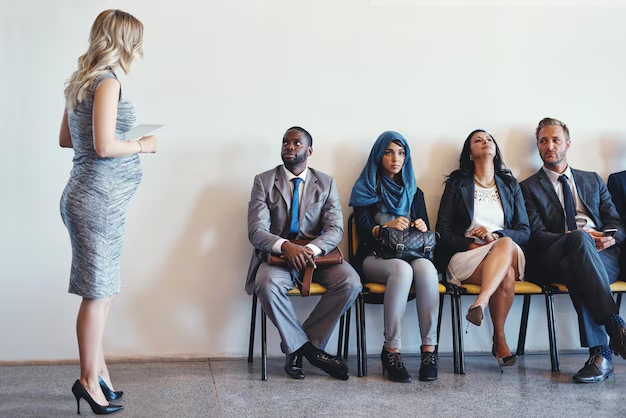
What to Wear to a Job Interview in 2025
First impressions start before you say a word. What you wear signals that you understand the company's culture, that you take the opportunity seriously, and that you have the self-awareness to read a room. In 2025, the rules haven't disappeared — they've just become more nuanced. Here's how to think through your interview outfit like a professional.
Why Interview Dress Still Matters (Even in a Casual World) 👔
Remote work, startup culture, and generational shifts in workplace norms have relaxed everyday dress codes across many industries. But relaxed day-to-day standards don't automatically transfer to interviews. Most hiring managers still form strong impressions within the first few minutes of meeting a candidate, and your clothing is part of that signal.
The goal isn't to look impressive in some abstract way — it's to look appropriate for the specific environment you're trying to join, while projecting competence and confidence. Those two things aren't always the same outfit.
The Most Important Variable: Company Culture
Before picking an outfit, research the company. Culture determines dress code more than any general rule does.
What to look for:
- The company's website and social media — do employees appear in photos? What are they wearing?
- Glassdoor or LinkedIn profiles of current employees
- The industry itself (finance, tech, healthcare, and creative fields each have distinct norms)
- The job level — an entry-level role at a creative agency and a senior role at a bank call for very different approaches
If you're unsure, it's generally safer to dress one level above what you expect the daily standard to be. Overdressing slightly is almost always less damaging than underdressing.
Understanding Dress Code Levels
| Dress Code | What It Usually Means | Typical Industries |
|---|---|---|
| Business Formal | Suits, ties, tailored dresses or skirt suits | Law, finance, executive roles |
| Business Professional | Polished separates, blazers, dress shirts — not necessarily a full suit | Corporate, healthcare administration, consulting |
| Business Casual | Neat slacks, blouses, button-downs, smart shoes — no tie required | Tech, marketing, mid-size companies |
| Smart Casual | Clean, put-together but relaxed — think elevated everyday wear | Startups, creative agencies, some retail |
| Casual | Rarely appropriate for interviews, even if it's the daily norm | Some creative or informal workplaces — confirm before assuming |
When in doubt, business casual to business professional is the safest range for most interview contexts in 2025.
What Works Across Most Interview Settings ���
Regardless of industry, certain principles hold up widely:
Fit is everything. Clothes that fit well look intentional. Ill-fitting clothes — even expensive ones — can undercut an otherwise strong presentation.
Neutral and understated tends to outperform bold. Navy, charcoal, grey, white, and black read as professional across most contexts. This doesn't mean you can't have a personality — a subtle pattern or a carefully chosen accessory can work well — but the outfit shouldn't be the thing people remember most.
Grooming and cleanliness matter as much as the clothes themselves. Wrinkled, stained, or worn-out clothing sends a message even if the style is right. Iron what needs ironing. Check for lint, scuffs, and loose threads the night before.
Comfort affects performance. If you're physically uncomfortable — shoes that pinch, a collar that chokes, a waistband that digs in — it will distract you. Wear something you can sit, stand, and walk in naturally.
Industry-Specific Guidance
Finance, Law, and Corporate Roles
These fields still lean formal. A well-fitted suit (or a tailored blazer with dress trousers or a skirt) in a dark or neutral tone is a reliable foundation. Conservative accessories and polished leather shoes or heels are standard expectations.
Tech and Startups
The range here is wide. Some tech companies have a genuinely casual culture, but a polished smart-casual or business-casual look usually signals the right balance of "I get your culture" and "I take this seriously." Dark jeans in excellent condition, a clean button-down or blouse, and neat footwear often land well — but this varies significantly by company and role level.
Healthcare and Education
Clinical or classroom environments often favor neat, practical clothing. Avoid anything too formal that signals you've misread the setting. Business casual generally works well. Follow any specific dress code instructions provided in advance.
Creative Fields (Design, Media, Advertising)
These are the spaces where personality in your clothing can actually be an asset — but the key is still intention. An outfit that looks deliberate and polished reads differently than one that looks like you just didn't try. Research the specific company's aesthetic before leaning into anything distinctive.
Common Mistakes That Undermine a Good Outfit
- Wearing something for the first time. New clothes can be stiff, unpredictable, or uncomfortable. Wear your interview outfit at least once before the day.
- Ignoring footwear. Shoes are noticed. Clean, appropriate shoes complete an outfit; scuffed or incongruous ones undercut it.
- Heavy fragrance. Strong cologne or perfume in a small room or on a video call can be distracting or off-putting. If you wear fragrance, use it very lightly.
- Visible logos or graphics. Unless you're interviewing somewhere where branded or graphic clothing is culturally appropriate, keep branding minimal.
- Overdressing in a way that signals you've misread the culture. A full formal suit for a casual startup interview can read as out of touch. Research first.
Virtual Interviews: What Changes ✅
Video interviews don't mean casual. Everything visible on camera counts — and that includes your background and lighting, not just your clothing.
For virtual interviews:
- Dress from the waist up at minimum, but fully dressing helps put you in the right headspace
- Avoid busy patterns — small checks, narrow stripes, or loud prints can distort on video
- Solid colors (especially medium tones) tend to read well on camera
- Ensure your clothing doesn't blend into your background
The same research and judgment that applies to in-person interviews applies here.
What You Actually Need to Decide
There's no universal right answer — but there is a process that helps you find your own:
- What does this company's culture look like? Research it specifically.
- What level is this role? Seniority affects expectations.
- What's the interview format? In-person, virtual, panel, or working session each have slightly different considerations.
- Do you have clothes that fit well and are in good condition? Fit and condition matter more than brand or price.
- Does your outfit let you focus on the interview, not your clothes? If you're comfortable and appropriately dressed, you can forget about it and concentrate on what you're saying.
The interview is the main event. Your outfit should set you up to perform well in it — and then get out of the way.